Creating a Trauma-Informed Classroom:
A Guide for Early Childhood Educators
If you’ve ever had a child in your classroom who seemed constantly on edge, quick to react, withdrawn, or unpredictable - you’re not alone. And more importantly, you’re not doing anything wrong. What you may be seeing is the impact of trauma.
In early childhood classrooms, trauma doesn’t always come with a clear story or a known event. Instead, it often shows up through behavior: big reactions, difficulty with transitions, or challenges with emotional regulation. And here’s the important part: this is exactly where educators can make a meaningful difference.
In early childhood classrooms, trauma doesn’t always come with a clear story or a known event. Instead, it often shows up through behavior: big reactions, difficulty with transitions, or challenges with emotional regulation. And here’s the important part: this is exactly where educators can make a meaningful difference.
What Early Childhood Educators Should Know About Trauma
Trauma refers to experiences that overwhelm a child’s ability to cope. This can include things like loss, instability, neglect, exposure to violence, or ongoing stress. These are known as Adverse Childhood Experiences (ACEs), and research shows they are more common than many people realize.
Trauma is not just what happens to a child - it’s how their brain and body respond to it. When children experience prolonged stress without consistent, supportive relationships, it can lead to toxic stress. This can affect brain development and influence how children learn, behave, and connect with others. If you’ve ever thought, “This behavior doesn’t match the situation,” you may be noticing the effects of stress beneath the surface.
One of the most powerful mindset shifts in trauma-informed teaching is moving from: “What’s wrong with this child?” to “What might this child have experienced?”
One of the most powerful mindset shifts in trauma-informed teaching is moving from: “What’s wrong with this child?” to “What might this child have experienced?”
How Trauma Can Show Up in the Classroom
Trauma doesn’t look the same for every child. It can vary widely based on age, the child’s temperament, and their developmental needs. In early childhood settings, it might show up as:
-
Big emotional reactions to small challenges
-
Withdrawal or shutting down during activities
-
Difficulty with transitions or changes in routine
-
Sensory sensitivities or strong sensory needs
-
Conflict with peers or trouble maintaining relationships
-
Trouble focusing on tasks or staying engaged
These behaviors are not about defiance or “attention-seeking.” They are often signs of a nervous system working overtime to feel safe. A trauma-informed lens helps educators look beyond the behavior itself and ask what the child may be communicating through it. Instead of asking, “How do I stop this behavior?” we ask, “What might this child have experienced, and what support do they need right now?” Instead of trying to control behavior, we build connection. That makes space for more empathetic responses. When educators use a trauma-informed lens, they are better able to recognize individual differences in how children express stress and create classroom environments where children can feel safe and understood. In other words, trauma-informed classrooms are more inclusive classrooms. And inclusive classrooms are better for everyone.
The Role of Relationships in Healing and Learning
The encouraging news is that trauma does not define a child’s future. Research from the Harvard Center on the Developing Child shows that supportive, responsive relationships with caring adults are one of the strongest protective factors for resilience.
That means your presence matters. Each time you stay calm, offer comfort during a challenging moment, create predictability, or help a child feel seen, you are doing meaningful work. These everyday interactions help build safety, trust, and the foundation for learning.
That means your presence matters. Each time you stay calm, offer comfort during a challenging moment, create predictability, or help a child feel seen, you are doing meaningful work. These everyday interactions help build safety, trust, and the foundation for learning.
Ready to Go Deeper? Explore the Full Course
If you’re ready to move beyond awareness and into practical application, our on-demand course
Trauma-Informed Classrooms: Healing and Resilience is designed to support you.
Inside the course, you’ll learn how to:
Trauma-Informed Classrooms: Healing and Resilience is designed to support you.
Inside the course, you’ll learn how to:
-
Recognize how trauma shows up from infancy through early elementary years
-
Use your relationship with students as a protective factor to build their resilience
-
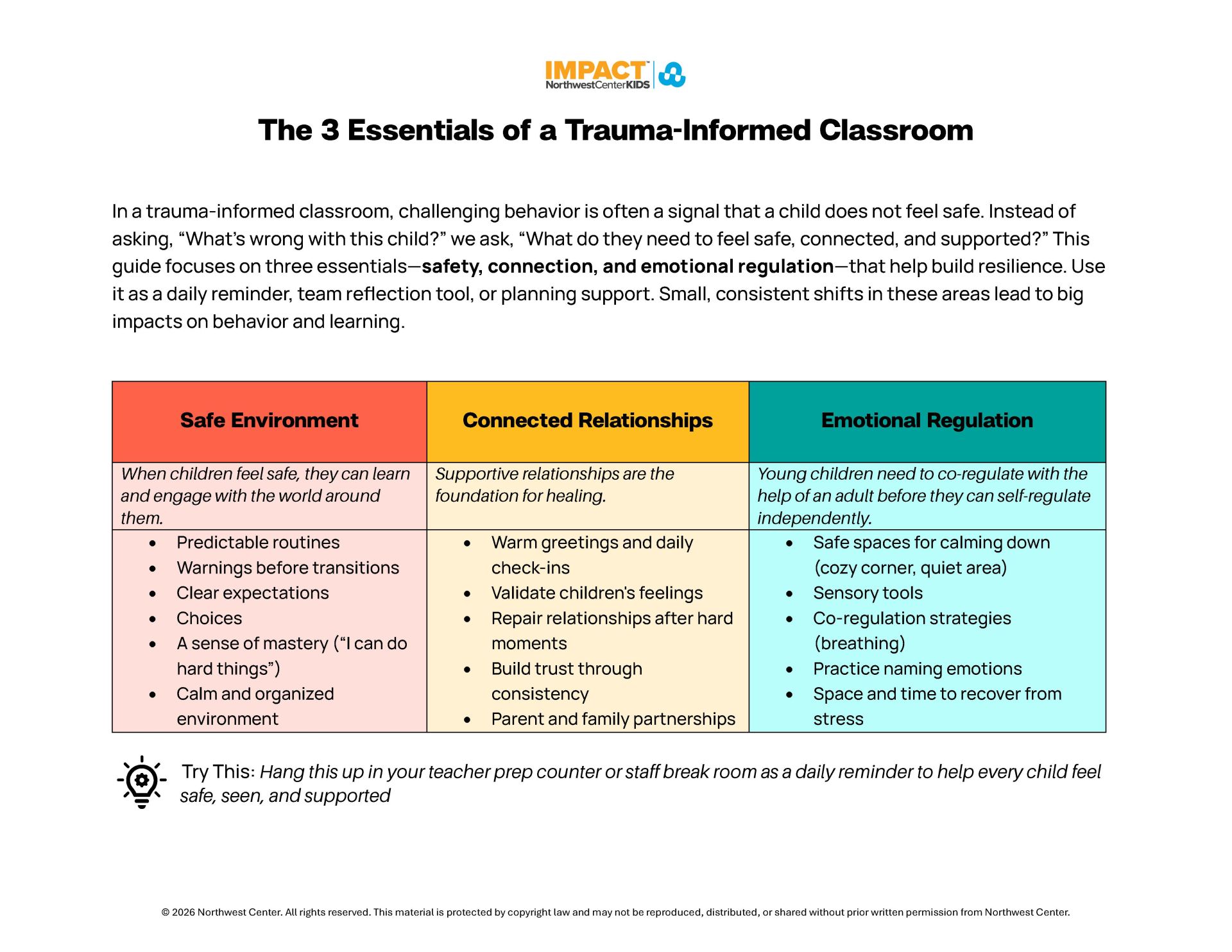
Apply 3 essential trauma-informed strategies - plus dozens of practical ways to bring them into your daily routines
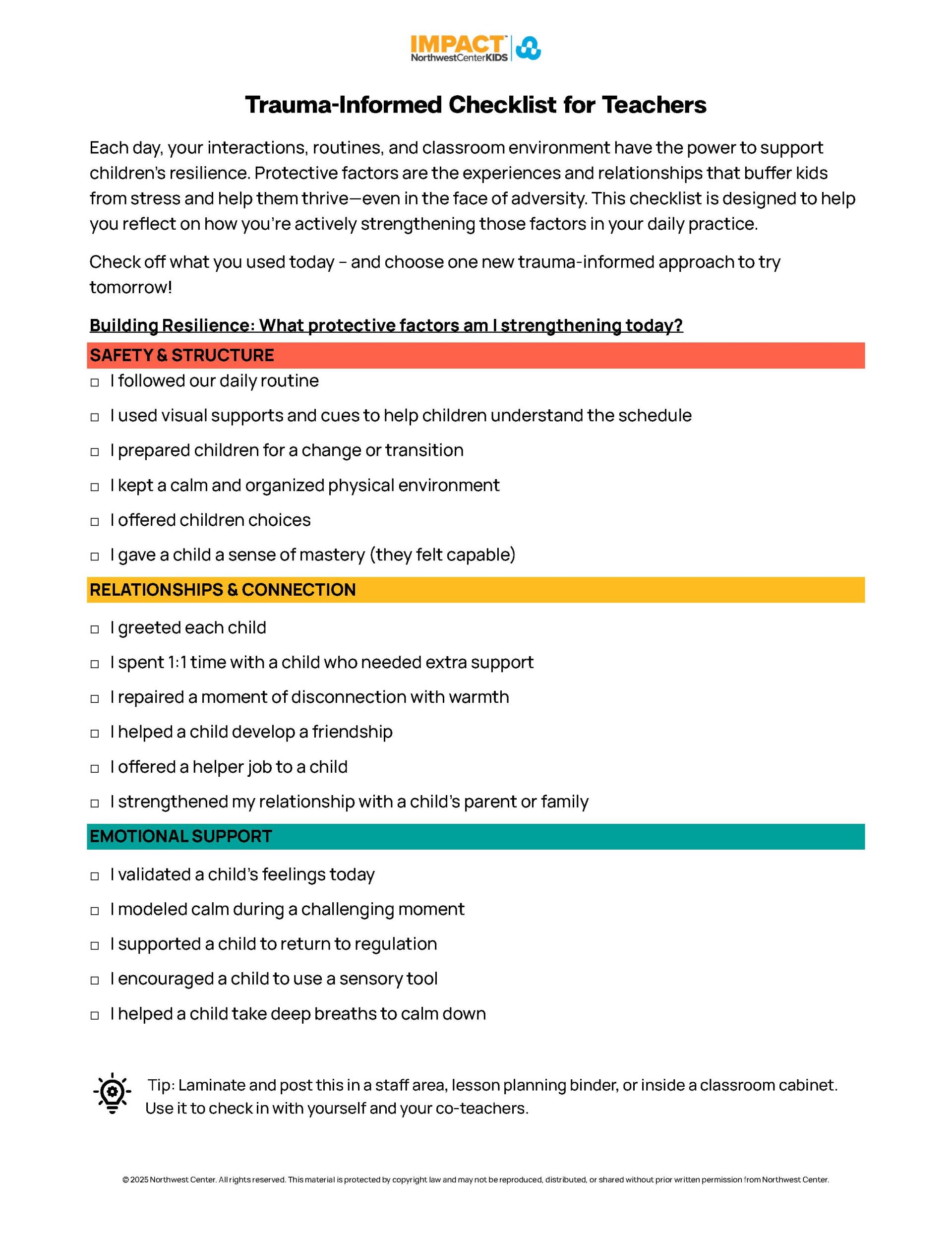
You’ll also get ready-to-use handouts that connect directly to your teaching practice, including:
-
A trauma-informed checklist to reflect on and strengthen your classroom
-
A strategy guide you can use for planning, problem-solving, and team discussions
These tools are designed to help you apply what you learn right away, in ways that feel realistic and sustainable.
A Final Thought
You may not always know what a child has experienced or what they’re carrying with them when they walk through your classroom door each day.
But you do have control over what they experience with you. In the way you greet them in the morning.
In how you respond when things get hard.
In the small moments of connection you build over time. These interactions send powerful messages: You’re safe. You belong. I’m here to help.
But you do have control over what they experience with you. In the way you greet them in the morning.
In how you respond when things get hard.
In the small moments of connection you build over time. These interactions send powerful messages: You’re safe. You belong. I’m here to help.
For children experiencing stress or trauma, those messages matter. They shape how children see themselves and how they relate to others. They support emotional regulation, build trust, and create the conditions children need to learn. You don’t need to have all the answers or the perfect response every time. What matters most is consistency, intention, and a willingness to see behavior through a different lens.
Often, it’s those small, steady shifts that make the biggest difference.
~The IMPACT Team
Often, it’s those small, steady shifts that make the biggest difference.
~The IMPACT Team
Note: Course links and offers mentioned in this post may have changed since publication. To see what’s currently available, visit our course library.
If you're interested in learning more about supporting children of all abilities in your classroom, check out these courses:
IMPACT™ content is developed by a multidisciplinary team and makes every effort to ensure that information provided reflect evidence-based, early childhood best practices. Providers should always follow local jurisdictions and other governing bodies rules and regulations when implementing any strategy or suggestion. Any actions, or lack of actions, are not the responsibility or liability of Northwest Center Kids – IMPACT™.
All content, including the presentation thereof on this web site, is the property of Northwest Center IMPACT™, and protected by U.S. and international copyright laws. You may not copy, reproduce, distribute, transmit, modify, create derivative works, or in any other way exploit any part of copyrighted material without the prior written permission from Northwest Center.
All content, including the presentation thereof on this web site, is the property of Northwest Center IMPACT™, and protected by U.S. and international copyright laws. You may not copy, reproduce, distribute, transmit, modify, create derivative works, or in any other way exploit any part of copyrighted material without the prior written permission from Northwest Center.
Connect
-
Seattle, WA
-
impact@nwcenter.org
-
NWC Home
Policy pages
Subscribe & stay up to date
Thank you!
Copyright © 2026
IMPACT™ content is developed by a multidisciplinary team and makes every effort to ensure that information provided reflect evidence-based, early childhood best practices. Providers should always follow local jurisdictions and other governing bodies rules and regulations when implementing any strategy or suggestion. Any actions, or lack of actions, are not the responsibility or liability of Northwest Center Kids – IMPACT™. All content, including the presentation thereof on this web site, is the property of Northwest Center IMPACT™, and protected by U.S. and international copyright laws. You may not copy, reproduce, distribute, transmit, modify, create derivative works, or in any other way exploit any part of copyrighted material without the prior written permission from Northwest Center.